

DANCES WITH THE WINDS

Oops! All Flutes!
You know the flute. But what about the piccolo, alto flute, and even the bass flute? All four members of the flute family will take a turn in an ethereal, snowy concerto by Finnish composer Einojuhani Rautavaara, performed by the winner of our 2024 Emerging Soloist Competition.
We’ve paired this piece with an inventive and witty suite by Jacques Ibert and Beethoven’s often-overlooked fourth symphony.
Jacques Ibert — Divertissement
Einojuhani Rautavaara — Flute Concerto “Dances with the Winds”
Ludwig van Beethoven — Symphony No. 4 in B-flat major
RUN TIME: 1 hour, 31 minutes (including intermission)
You’ll See: 4 Different Kinds of Flutes

You’ll Hear: Beethoven’s Most Underrated Symphony

You’ll Feel: Connected to Nature

Choose Your Date:
DEC 6th
2025
Saturday, 7:00PM
Ent Center for the Arts
DEC 7th
2025
Sunday, 2:30PM
Ent Center for the Arts
This Concert’s Music Made Possible by:
2025-26 Season Sponsor:

Music Sponsors:
Doug & Dianne Herzberg
Carol & Jim Montgomery
Gary & Patricia Morrell
Guest Artist Sponsors:
Carol & Jim Montgomery
Featuring:
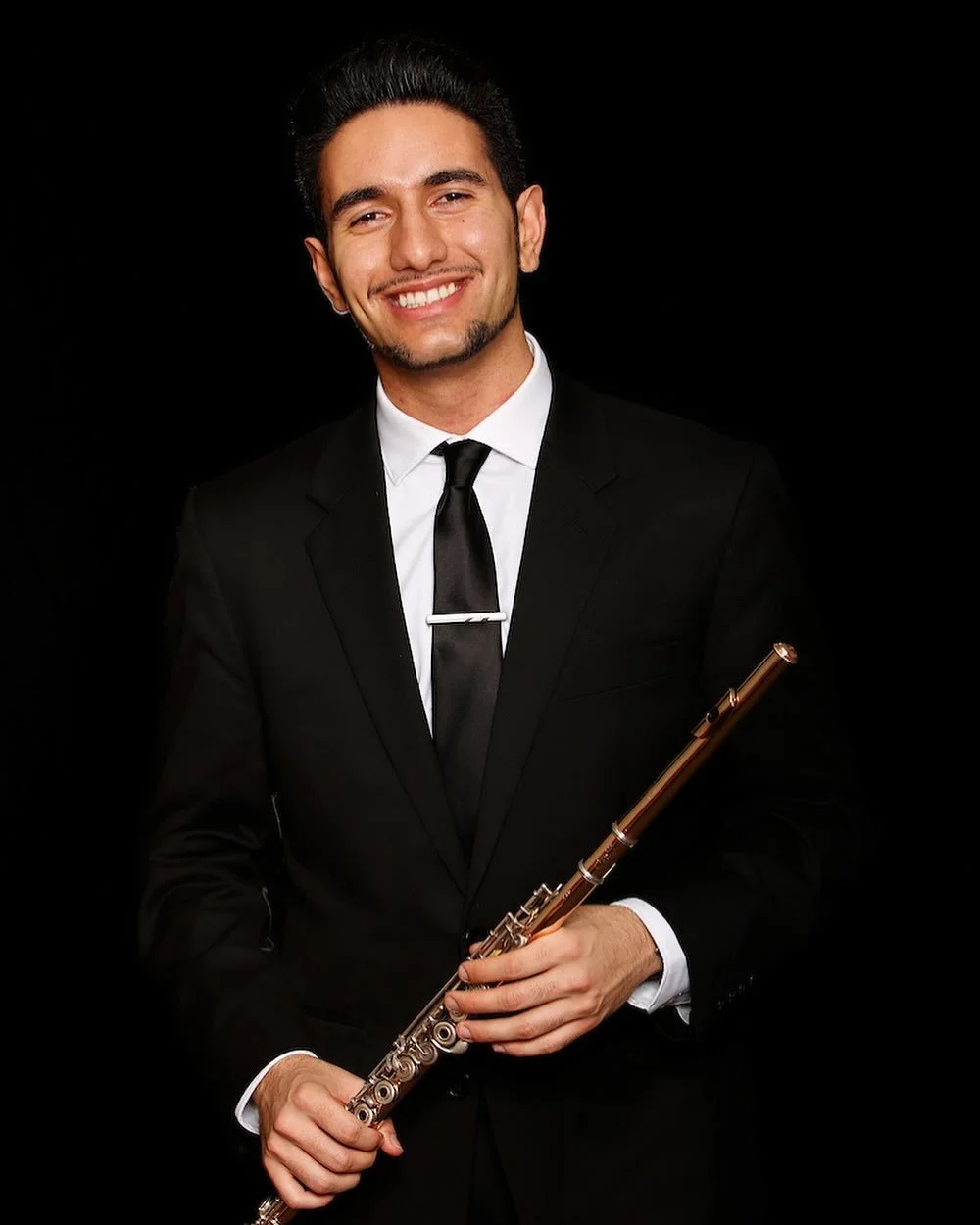
-
Residing in British Columbia, Canada, Arin Sarkissian is the Principal Flutist of the Victoria Symphony.
The Toronto-born artist was awarded the 2024 Michael Measures 1st Prize by the Canada Council for the Arts. In the summer of 2022, he made guest appearances at Orchestre symphonique de Montréal’s La Virée Classique, as the recipient of 1st Prize and Stingray Audience Choice at the 2020 OSM Competition. Recent orchestral appearances include concerts as Guest Principal Flute with the Los Angeles Chamber Orchestra and substitute invitations with the National Arts Centre Orchestra and Vancouver Symphony. He has performed under the baton of Michael Tilson Thomas, Marin Alsop, Jamie Martín, Larry Rachleff, James Conlon, JoAnn Falletta, Carlos Miguel Prieto, Sir Andrew Davis, Osmo Vӓnskӓ, Stéphane Denève, Tania Miller, and Otto Tausk, alongside others.
In 2022, Arin was named a Yamaha Young Artist Performance Competition Winner and won 1st Place at the Nancy Clew Eller, Music Teachers National Association, San Diego Flute Guild, and Naftzger Young Artist competitions. Other awards include 3rd Prize in the 2020 National Flute Association Young Artist Competition, 1st Prize in the 2020 Young Texas Artists Music Competition, and 1st Prize in the 2019 Mika Hasler Young Artist Competition. Former festival engagements include invitations to the Music Academy of the West, National Youth Orchestra of Canada, New York String Orchestra Seminar, National Symphony Orchestra Summer Music Institute, and Carnegie Hall’s National Youth Orchestra of the United States.
Named in the 2022 edition of CBC’s “30 hot Canadian classical musicians under 30,” Arin has recently been called for as a soloist. In March of 2023, he performed J.S. Bach’s Triple Concerto alongside Canadian pianist Angela Hewitt with the Victoria Symphony under conductor Christian Kluxen. Amongst his guest performances with the Orchestre symphonique de Montréal in 2022 were a spotlight chamber recital and an unaccompanied highlight with Debussy’s “Syrinx” for solo flute. That same year, Arin curated a recital for the Ottawa Chamberfest as an ambassador of the National Youth Orchestra of Canada, presenting solo and chamber works at the National Arts Centre. He was also featured as a soloist alongside Canadian violinist Blake Pouliot in a unique performance of Vivaldi’s Double Violin Concerto in D Major, RV 512, at the Isabel Bader Centre in Kingston, Ontario.
Arin was a featured soloist with the Victoria Symphony in October of 2023, bringing Carl Nielsen’s Concerto for Flute and Orchestra to life alongside his colleagues. Also on the program was Arin’s presentation of Edgard Varèse’s “Density 21.5,” perhaps the first unaccompanied solo in the history of the Victoria Symphony and a rare feature amongst orchestra programs worldwide. Other regional features include a chamber recital at the Wentworth Villa in October 2023 and soloist engagement in Carl Reinecke’s Flute Concerto with the Port Townsend Symphony Orchestra in December 2023. In May of 2024, Arin is invited to present a solo recital on behalf of the Montreal Symphony, to be streamed nationwide through ICI Musique.
Arin also enjoys performing alongside harpist Kaitlin Miller as Duo Duoro. Formed in Los Angeles in 2022, the flute and harp duo aims to showcase their instrument pairing through adventurous programs of undiscovered soundscapes and diverse musical identities. Most recently, Duo Duoro went on tour throughout central Washington as 1st Prize winners in the 2024 Frances Walton Competition, including professional engagements with Classic KING-FM and state-wide outreach initiatives hosted by the Ladies Musical Club of Seattle. They were semifinalists in the Concerts Artists Guild 2024 National Auditions and were selected as recommended artists by the Beverly Hills National Auditions and Consortium of Chamber Presenters of Southern California.
Arin graduated in the class of 2021 from Rice University with a Bachelor of Music in Flute Performance with Distinction in Research and Creative Works, studying under the professorship of Leone Buyse. He also obtained a Performance Certificate from The Colburn School, where he studied with Jim Walker in Los Angeles. Arin performs on a Haynes Custom flute, working with Cynthia Kelley as his primary flute technician. His previous mentors are Lilit Hovhannisyan and Christina Yoo, and he looks forward to sharing the gift of music with the world.
Learn About the Music:
-
Composed 1930, by Jacques Ibert (1890-1962).
Born in Paris in 1890, Jacques Ibert grew up in a musical household and showed early talent at the piano, though his father initially encouraged a more practical career. After working briefly in the family business, Ibert entered the Paris Conservatory in 1911. His training was interrupted by World War I, during which he served in a medical unit in the French Navy, for which he earned the Croix de Guerre – a medal conferred for acts of bravery. Returning to music after the war, he quickly distinguished himself by winning the prestigious Prix de Rome in 1919, France’s highest award for young artists, which provided for Ibert to further his studies in Rome for three years.
Ibert's time in Rome sparked an outpouring of creativity, with an output that included shimmering orchestral suites, operas, ballets, chamber works, and over sixty film soundtracks. Just as important were his roles in French cultural life – most notably as the first musician ever appointed director of the French Academy at the Villa Medici in Rome, a post he held (with a World War II interruption) from 1937 to 1960. Throughout his life he resisted aligning with any particular musical school, preferring clarity, independence, and expressive freedom.
Those qualities shine brightly in Divertissement, a six-movement suite drawn from Ibert’s incidental music for a 1929 staging of the classic French farce The Italian Straw Hat. True to its title – meaning “amusement” or “entertainment” – the piece is a riot of wit, elegance, and irreverent humor. The miniature overture that opens the suite gives way to a cheeky Cortège (complete with a sly quotation of Mendelssohn’s Wedding March), followed by a gentle Nocturne, and a deliciously “wrong-note” Waltz that pokes fun at other famous waltzes from the era, including Blue Danube. After a short Parade, a chaotic piano cadenza launches the Finale in a whirlwind of comic energy.
Scored for a modest orchestra, Divertissement nevertheless dazzles with brilliant color – proof of Ibert’s effortless craftsmanship and his gift for transforming even the lightest music into something irresistibly alive.
Note by Jacob Pope
-
Composed 1974, by Einojuhani Rautavaara (1928 - 2016)
What I find most fascinating about Einojuhani Rautavaara's evolution as a composer is his somewhat “roundabout” journey of finding his musical voice. The trend of the latter 20th-century was to write music that pushed the academic envelope; the period was heavily shaped by the idea that “serious” composers needed to engage with modernist techniques to gain respect in the field and for their work to be of value. Rautavaara felt this pressure – he clearly experimented with 12-tone serialism, aleatoric textures (music that literally depends on randomness!), and even electronic music. Long story short, from the 1960s to early 1970s, Rautavaara’s music was quite rigorous in both methodology and aesthetic.
I’ll be honest with you. As someone who didn’t quite grow up with classical music as a household staple, these sorts of modernist compositions never really appealed to my ears. Even today, after years of performing and studying music in institutional settings, my appreciation for this music seems somewhat exclusive to a scholarly lens – yes, impressive from a compositional perspective, but not always the most fun to play or listen to. The reaction of my parents when they hear me perform these pieces totally paints the picture – my dad (who’d frankly be happy hearing Star Wars music at every concert) struggles to call these sorts of pieces “music,” and my polite yet most honest mom can only sum up the guts to call them “...interesting?” I get it, mom and dad!
This is what’s so special about Rautavaara to me. By the mid-70s, I feel that he finally found himself, brave enough to embrace his most authentic artistic self. He himself admits it in an interview in 1996: “I couldn’t go on that way, on that path, because that was not the kind of music I wanted to hear.” His musical output changed dramatically, shifting from what once catered to these academic pressures to something that truly spoke to his heart, I sense. The result? Music full of the most beautifully soaring melodies, vivid orchestrations that transport any listener beyond their immediate reality, and timeless pieces that will live on beyond his recent passing in 2016.
This flute concerto is perfect testament to Rautavaara’s return to music that moves. Wish me luck as I juggle between four different flutes - “C” flute, piccolo, alto flute, and bass flute - in a piece that demands for an extraordinary variety of colors and sound palettes.
In some moments the music exhibits a primal quality, painting pictures of street songs or lousy carnival music. In other moments you might find yourself face to face with the cosmos, hearing celestial soundscapes that depict the most expansive of Nordic landscapes (I picture cold, misty mountains, vast arctic tundras, maybe even a frozen lake under Northern Lights). With sweeping gestures of naturalistic flair and sonic illustrations of monumental forces, I find myself wondering if Rautavaara’s curiosity for spirituality and his “taste for the infinite” seep through this haunting piece of music… all that said, I am grateful for this absolute treasure of a piece and excited for you all to hear it today.
I leave you with the most beautiful sentiment from Rautavaara himself:
“It is my belief that music is great if, at some moment, the listener catches a glimpse of eternity through the window of time… This, to my mind, is the only true justification for art. All else is of secondary importance.”
Note by the soloist, Arin Sarkissian
-
Composed 1806–7, by Ludwig van Beethoven (1770 - 1827)
Beethoven’s Fourth symphony is the middle child: often overlooked between its attention-hogging siblings, the revolutionary Third and the fate-obsessed Fifth, but brilliant in its own right. It doesn’t demand the spotlight. It earns admiration with wit, sparkle and the kind of confidence necessary for anyone who grew up around loud brothers. Ironically, it also has the misfortune of sharing its era with several formidable “cousins”: the Appassionata Piano Sonata, the three Razumovsky String Quartets, Fidelio, Piano Concerto No. 4, and the Violin Concerto. And so, the Fourth sits quietly and waits.
The premiere was a private house concert in Vienna, March 1807. The first public performance was a year later in April at the Burgtheater. Beethoven started composing the symphony in 1806 after meeting Count Franz von Oppersdorff, a Silesian nobleman who commissioned it for 500 florins. At the time, Beethoven was staying at the estate of Prince Lichnowsky. Although Beethoven had already begun sketching ideas for what would become the Fifth, he set that aside for this project, writing the Fourth even though he had a dramatic falling out with Lichnowsky. The story goes (an anecdote recounted by Beethoven’s friend Ferdinand Ries) that when Lichnowsky requested Beethoven to improvise for French soldiers, Beethoven reportedly stormed out of the palace, smashing a bust in the process.
Regardless of broken statues, there is still drama in the Fourth, just not the monumental drama we have come to associate with Beethoven. He embraces a more Classical poise: a smaller orchestra relatively speaking and an economical 30-plus minutes rather than an epic hour. And within a Classical frame he introduces subtle surprises, like the atmospheric slow introduction, which wanders through minor harmonies before jumping into a lively Allegro as well as a tiny, ingenious motif. Listen for a short three-note figure built around a leap of a third.
The movement you should take special note of is the Adagio, one of the most tender slow movements in all of Beethoven’s symphonic output. It’s possible that it reflects his emotional state at the time. Around 1805–1807, Beethoven was deeply in love with Josephine Brunsvik, and as surviving letters reveal, the relationship seemed to awaken a gentler, more romantic side.
The Menuetto (marked Allegro vivace) features playful, cat-and-mouse exchanges between woodwinds and strings, built around a mischievous theme. The contrasting trio highlights charming woodwind solos.
The finale is a spirited, high-speed romp. It opens with a dazzling perpetual-motion violin theme. Building to a vigorous climax, Beethoven caps the symphony with humorous touches before racing to its close.
Although the Fourth has sometimes been misunderstood and overshadowed, champions such as Schumann, Mendelssohn, and Berlioz recognized its elegance. Schumann famously called it a “slender Greek maiden between two Norse giants.” Berlioz wrote, “The general character of this score is either lively, alert, and gay, or of a celestial sweetness.”
The Fourth is balance, humor, and invention. And in true middle-child fashion, it waits patiently, knowing that once you finally notice it, you will wonder how you ever overlooked it.
Note by Pam Chaddon
View the Program:
WHAT TO KNOW
VENUES
This concert is held at the Ent Center for the Arts (Map) in the Chapman Recital Hall - 5225 N Nevada Ave, in Colorado Springs, CO.
Doors open 1 hour + 15 minutes prior to the performance.
PARKING
Free parking is available on-site in Lot 576 - for those with mobility needs, Lot 176 is available and adjacent to the building.
PRE-CONCERT ACTIVITIES
A pre-concert performance by the flute choir “Micro Brew Crew” will begin in the lobby 45 minutes before the performance.